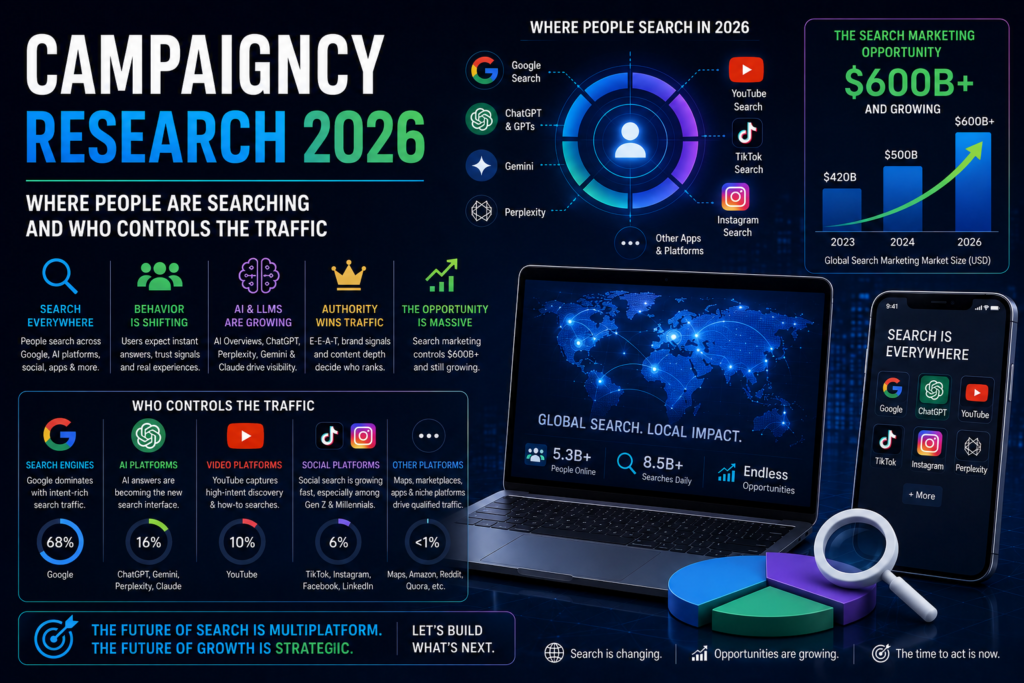
Published by Shahzaib Ali | April 2026 | Research & Insights Division
At Campaigncy, we track where audiences actually live — which platforms they use, how they discover information, and where brand visibility is won or lost. In 2026, that question has a more complex answer than ever before. The search landscape has officially split into two parallel universes: traditional search engines and generative AI engines. If your brand is only optimising for one, you’re already invisible to a growing slice of your audience.
Here’s the full picture.
Global searches/day – 8.5B
AI chatbot visits/day – 290M
Search market value – $228B
Zero-click Google searches – ~58%
Part 1 — Traditional Search Engines: The Old Guard Still Dominates
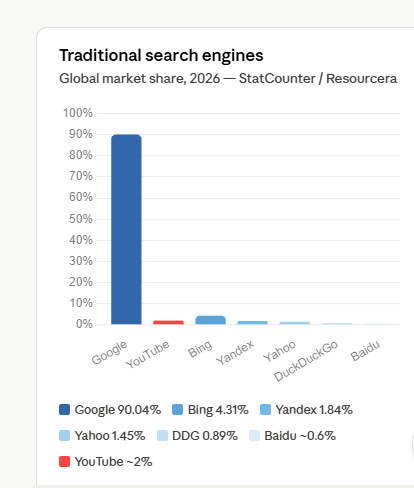
Traditional search engines remain the backbone of digital discovery. Google alone processes approximately 8.5 billion searches per day and controls 91.4% of the global search market Colorlib, a stranglehold that has held for over a decade. But cracks are forming.
Google’s global market share has slipped from 93.37% in February 2023 to around 90% in early 2026, while Bing has climbed from 2.81% to nearly 5% over the same period Impression — its highest share in history, driven largely by its Copilot AI integration.
Here is where the search traffic sits today:
| Platform | Global Market Share (2026) | Notes |
| 90.04% | Near-monopoly; losing marginal ground | |
| YouTube | ~2% | World’s #2 video search engine |
| Bing | 4.31% | Rising; powered by Microsoft Copilot |
| Yandex | 1.84% | Dominant in Russia (~65% locally) |
| Yahoo | 1.45% | Declining steadily |
| DuckDuckGo | 0.89% | Privacy-focused; growth has plateaued |
| Baidu | ~0.60% | Dominant in China (~75–85% locally) |
Source: Resourcera / StatCounter, February–April 2026
One major behavioral shift is rewriting the value of search traffic itself. A staggering 50.33% of all Google searches now end without a single click to a website Sociallyin, as answers appear directly on the results page via AI Overviews. More searches. Less traffic. That is the paradox brands must now navigate.
The global search engine market is valued at $228.42 billion in 2026 and projected to reach $587.75 billion by 2035, expanding at an 11% CAGR. Business Research Insights
Part 2 — Generative AI Engines: The New Search Frontier
This is where the real disruption lives. In just 12 months, the AI chatbot ecosystem has gone from a one-horse race to a genuinely competitive battlefield — and it is reshaping how younger, research-driven, and professional audiences find information.
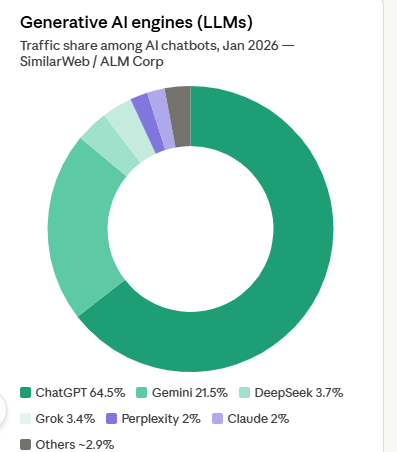
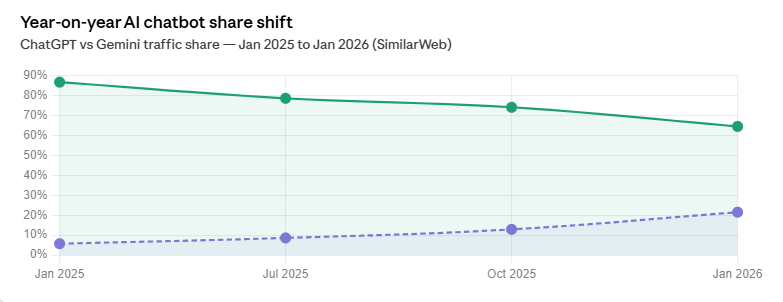
ChatGPT’s traffic share dropped from 86.7% in January 2025 to 64.5% by January 2026, while Google Gemini surged from 5.7% to 21.5% over the same period. Wallaroo Media That is a seismic shift in twelve months.
| Platform | AI Traffic Share (Jan 2026) | Strengths |
| ChatGPT | 64.5% | General use, creative tasks, widest reach |
| Gemini | 21.5% | Google ecosystem, Android integration |
| DeepSeek | 3.7% | Strong in Asia, open-source adoption |
| Grok | 3.4% | X/Twitter integration, real-time data |
| Perplexity | 2.0% | Research, cited sources, high-intent queries |
| Claude | 2.0% | Enterprise, legal, coding, document analysis |
| Meta AI | Embedded | WhatsApp, Instagram, Facebook — mass reach |
Source: SimilarWeb / ALM Corp, January 2026
Claude holds approximately 3.2% of the US consumer market but accounts for 21% of global LLM API usage, with 45% of its traffic originating from enterprise customers Views4You — a reminder that market share percentages don’t always reflect where the real commercial value sits.
Perplexity experienced 370% year-over-year growth by positioning itself as an AI-first search engine rather than a general chatbot ALM Corp, targeting users who want cited, research-grade answers — a segment that is deeply valuable to brands in finance, health, and professional services.
Part 3 — The Scale Reality Check
Before brands over-rotate toward AI engines, the scale gap must be acknowledged. The entire standalone AI chatbot category — ChatGPT, Gemini, Claude, and all others combined — receives approximately 290 million daily visits. Google alone processes 8.5 billion queries per day. Wallaroo Media That is a 29:1 ratio. Google’s embedded AI, through AI Overviews appearing on hundreds of millions of queries daily, likely makes it the dominant AI-assisted discovery platform by volume — not ChatGPT.
The smart strategic read for 2026 is not either/or. It is both — with budget and content strategy weighted by where your specific audience actually spends their search intent.
What This Means for Your Brand in 2026
The era of “rank on Google and you’re done” is over. Audiences are fragmenting across platforms based on task type — they research on Perplexity, create on ChatGPT, transact via Google, and browse on YouTube. A brand that is visible on only one layer of this ecosystem is already losing ground to competitors who are optimising across all of them.
Traditional SEO, Generative Engine Optimisation (GEO), and platform-specific content strategies are no longer separate conversations. In 2026, they are the same conversation.
This research was produced by the Campaigncy Insights Team using data from StatCounter, Resourcera, SimilarWeb, ALM Corp, Colorlib, Wallaroo Media, and WebFX — all sourced and verified as of Q1–Q2 2026.
Want your business or brand to show up where your audience is actually searching? Whether it’s Google, AI engines, YouTube, or the platforms shaping 2026 discovery — Campaigncy builds the strategy to put you there. Get in touch at Campaigncy.com